





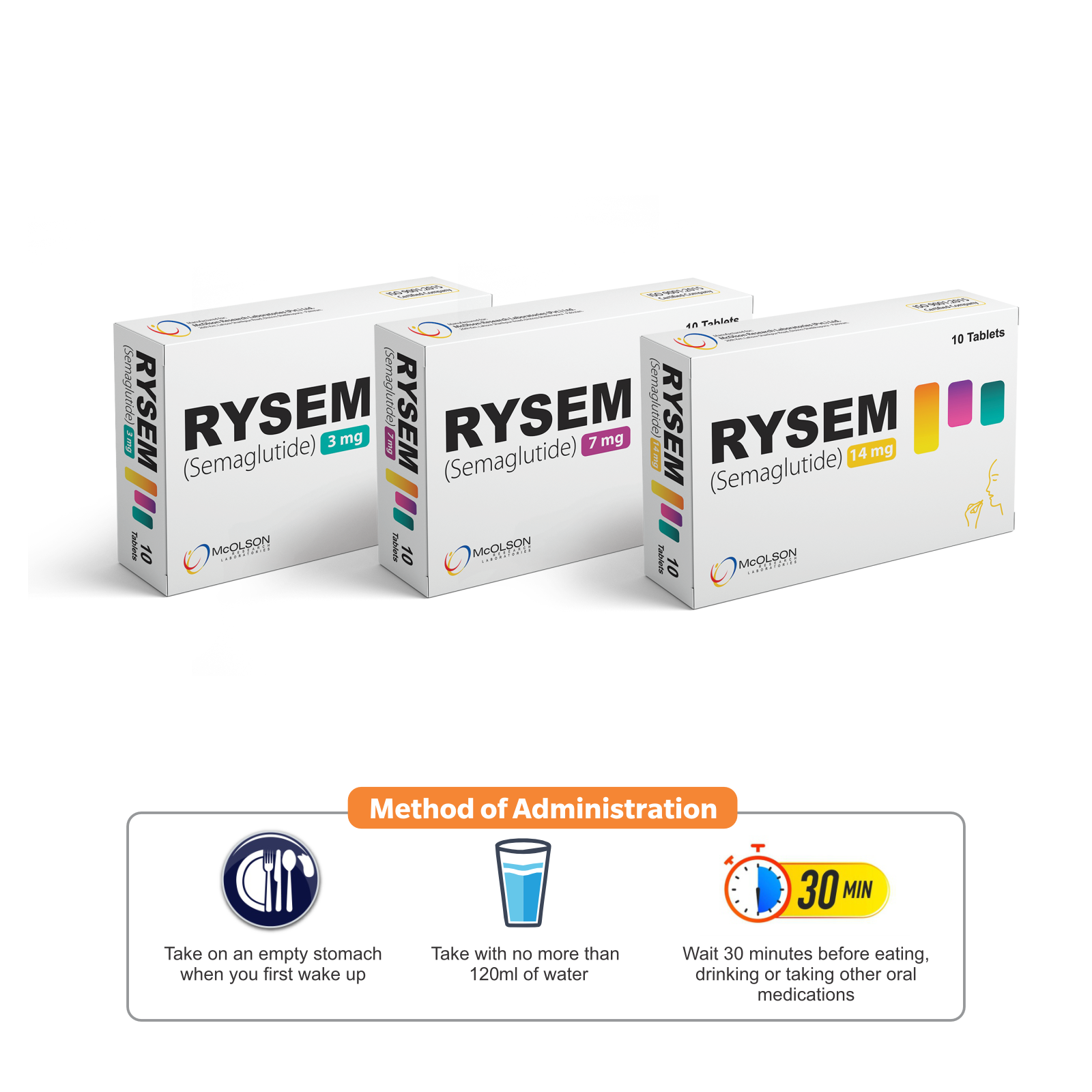
Rysem (Semaglutide)3mg / 7mg / 14mg
Description:
Rysem (Semaglutide) Tablets, for oral use, contain semaglutide, a GLP-1 receptor agonist. The main protraction mechanism of semaglutide is albumin binding, facilitated by modification of position 26 lysine with a hydrophilic spacer and a C18 fatty di-acid. Furthermore, semaglutide is modified in position 8 to provide stabilization against degradation by the enzyme dipeptidyl-peptidase 4 (DPP-4). A minor modification was made in position 34 to ensure the attachment of only one fatty di-acid. The molecular formula of Semaglutide is CHaNO
Generic:
Semaglutide
QUALITATIVE AND QUANTITATIVE COMPOSITION
Rysem (Semaglutide) is available for oral administration as:
Rysem Tablet 3mg Each tablet contains:
Semaglutide…3mg
Innovator’s Specs
Rysem Tablet 7mg Each tablet contains:
Semaglutide.. 7mg
Innovator’s Specs
Rysem Tablet 14mg
Each tablet contains:
Semaglutide… 14mg
Mechanism of Action
Semaglutide is a GLP-1 analogue with 94% sequence homology to human GLP-1. Semaglutide acts as a GLP-1 receptor agonist that selectively binds to and activates the GLP-1 receptor, the target for native GLP-1. GLP-1 is a physiological hormone that has multiple actions on glucose, mediated by the GLP-1 receptors. The principal mechanism of protraction resulting in the long half-life of Semaglutide is albumin binding, which results in decreased renal clearance and protection from metabolic degradation. Furthermore, Semaglutide is stabilized against degradation by the DPP-4 enzyme. Semaglutide reduces blood glucose through a mechanism where it stimulates insulin secretion and lowers glucagon secretion, both in a glucose-dependent manner. Thus, when blood glucose is high, insulin secretion is stimulated and glucagon secretion is inhibited. The mechanism of blood glucose lowering also involves a minor delay in gastric emptying in the early postprandial phase.

Recent Comments